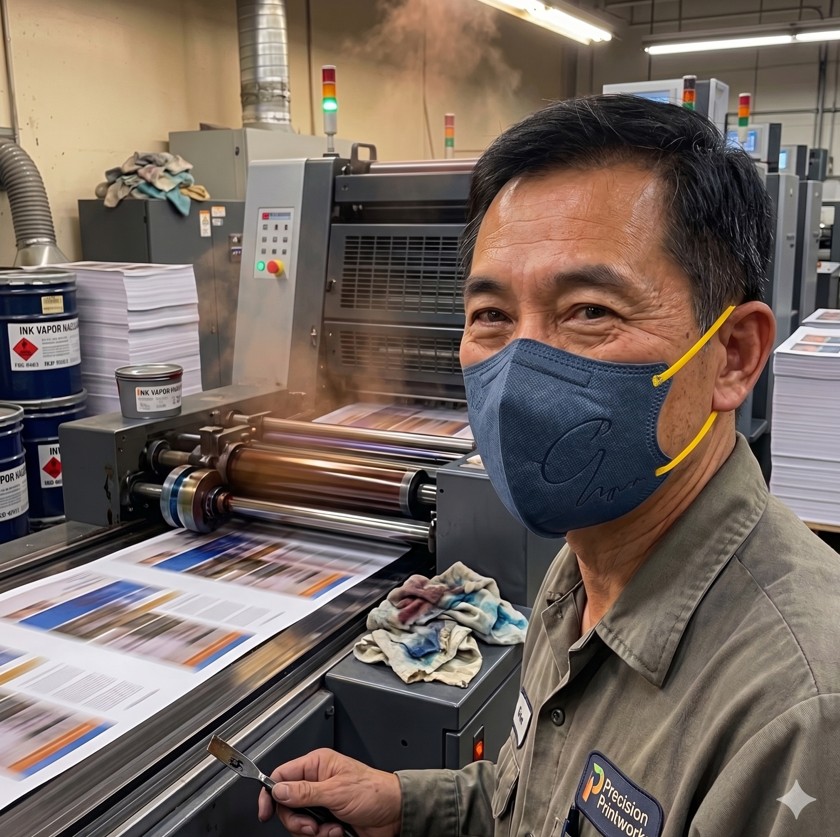



Is It More Dangerous if You Can't Smell the Ink? Uncovering the Truth About "Olfactory Fatigue" in Printing Factories: Protect Your Lung Health
Why Olfactory Fatigue is a Dangerous Signal
In a printing factory, visitors often complain about the overwhelming chemical smell immediately upon entry. However, many frontline workers simply reply: "You get used to it after a while; it’s not that bad."
This lack of sensation doesn't mean the environment is safe. It is often a result of Olfactory Adaptation, where the sense of smell becomes dull due to constant stimulation. Just because you can no longer smell the pollutants doesn't mean they have disappeared; they continue to enter your body with every breath.
Common Sources of Air Pollution in the Printing Industry
A printing workspace involves more than just paper and machines. It contains several overlooked sources of exposure:
-
Ink and Ink Mist: During high-speed operation and drying, ink can form fine aerosols and volatile substances that linger in the air.
-
Wash Water and Cleaning Solvents: Solvents used to clean equipment release high levels of Volatile Organic Compounds (VOCs), which are the primary source of pungent odors.
-
Paper Dust and Cutting Debris: Handling and cutting paper generates fine dust. While less visible than large debris, these particles stay suspended in the air for long periods.
-
Mixed Occupational Exposure: Printing factories usually involve a combination of "Oily Particles + Volatiles + Dust," requiring comprehensive respiratory protection.
If You Can't Smell the Ink, You Should Be More Careful
Many people mistakenly believe that if the air were truly harmful, it would feel unbearable. In reality, the brain reduces sensitivity to constant smells—this is known as "Sensory Adaptation."
However, your lungs do not "adapt." When you no longer find the smell pungent, the oily particles, VOCs, and suspended debris are still entering your nasal cavity, trachea, and lungs. You haven't stopped inhaling them; you've just stopped noticing them.
Signs Your Health is Affected by Air Exposure
If you experience the following symptoms after work, do not ignore them as "normal":
-
Dry or itchy throat.
-
Nasal congestion or a runny nose.
-
Frequent coughing or clearing your throat.
-
Dizziness or a feeling of "heavy air."
-
Persistent ink or solvent smells on your clothes and skin after work.
Why Standard Masks Fall Short in Printing Factories
Printing environments contain a mix of oily aerosols and fine dust.
-
Standard Masks: Often provide insufficient filtration for oily chemical particles.
-
Traditional High-Protection Masks: While effective, they are often too hot and difficult to breathe through, making them hard to wear for long shifts.
-
The Goal: Truly effective protection must be both high-spec and comfortable enough to wear all day.
Why Professionals Choose :dc Respiratory Protection Masks
For those in the printing industry, respiratory protection should be a daily standard, not an occasional precaution.
Key Features of :dc Mask:
-
Nano-Membrane Filtration: Uses physical barrier technology rather than just static electricity to effectively block oily particles, ink mist, and fine paper dust.
-
Enhanced Comfort for Long Shifts: :dc emphasizes breathability, making it suitable for high-temperature or long-hour factory environments.
-
Designed for Mixed Exposure: Specifically built to handle the combination of paper dust, ink aerosols, and PM2.5 particles.
-
Washable and Reusable: Provides a cost-effective and sustainable solution for daily professional use.
Best Practices for Printing Factory Safety
-
Enhance general ventilation and local exhaust systems.
-
Perform regular maintenance to reduce solvent leakage.
-
Use personal protection during paper cutting and machine cleaning.
-
Treat respiratory protection as a daily standard, not an optional tool.
Frequently Asked Questions (FAQ)
Q1: If I’m used to the ink smell, does it mean my body has adapted?
No. It means your sense of smell has become desensitized. The pollutants are still present and being inhaled into your lungs.
Q2: Is the smell the only problem in printing factories? No. Oily aerosols, VOCs, and fine paper dust are often odorless or invisible but represent significant health risks.
Q3: Can a regular medical mask protect me? Generally, no. For environments with oily ink mist and solvent vapors, professional-grade protection designed for industrial exposure is recommended.
Q4: Why do workers avoid high-protection masks? Usually due to heat and breathing resistance. DCTPRO solves this by combining high filtration with superior breathability.
Protecting the quality of the print is important, but protecting your lungs is vital.
Call to Action (CTA)
If you work in a printing factory and are looking for a mask that is easier to wear than a traditional N95 while providing superior protection against oily particles, contact DCTPRO today.
-
Line@: @dctpro
-
Customer Service: 04-26810387